
FOUP Injection Molding Machine: Complete Guide for Semiconductor Wafer Carrier Manufacturing
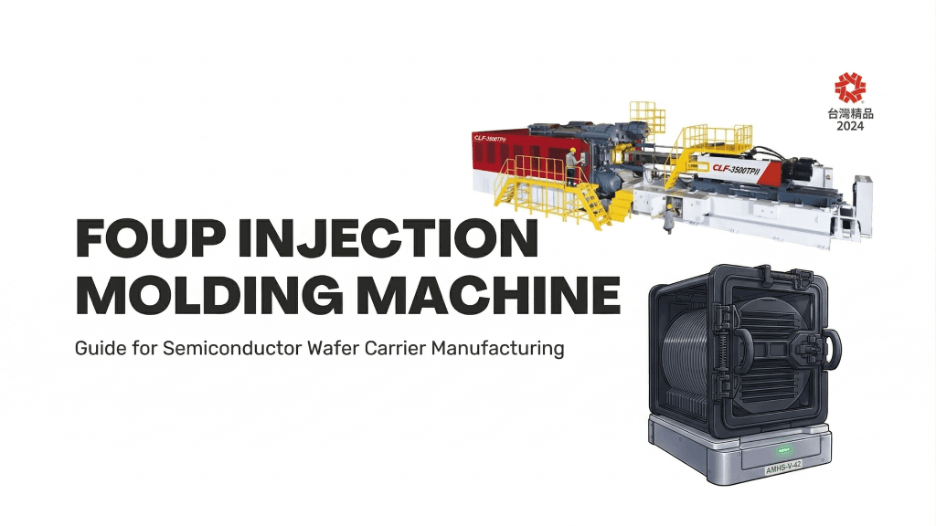
In the high-stakes high-precision semiconductor packaging landscape, the production of Front Opening Unified Pods (FOUPs) has evolved far beyond basic plastic fabrication. These specialized carriers are indispensable to automated fabrication facilities (fabs), serving as the primary wafer transport solutions for the secure handling of 300 mm wafers.
Manufacturing these units demands high-precision injection molding systems capable of ensuring unparalleled dimensional stability and stringent contamination control. Ultimately, producing a FOUP is an exercise in engineering an ultra-clean micro-environment for the world’s most sensitive cargo.
As we move through 2026, the industry benchmark has shifted. It’s no longer just about capacity; it’s about sub-millimeter dimensional integrity and absolute contamination control. In this environment, a 3000-ton two-platen injection molding system is not an alternative—it is a strategic necessity for any manufacturer serious about entering the Tier-1 semiconductor supply chain.
What Is a FOUP Injection Molding Machine?
A FOUP injection molding machine is a high-precision system engineered for the fabrication of Front Opening Unified Pods (FOUPs). These standardized vessels are essential for the secure transit of 300 mm semiconductor wafers within automated fabrication facilities (fabs).
Due to the stringent tolerances required for dimensional stability, contamination control, and electrostatic discharge (ESD) protection, the production of these pods necessitates high-tonnage injection molding machines, typically spanning the 2000 to 3000-ton range.
These systems deliver the requisite clamping stability and precision to mold large carriers with sub-millimeter accuracy while minimizing internal stress. This ensures seamless integration with the sophisticated automated wafer-handling systems prevalent in modern fabs.
Why FOUP Containers Require Ultra-High Precision Manufacturing
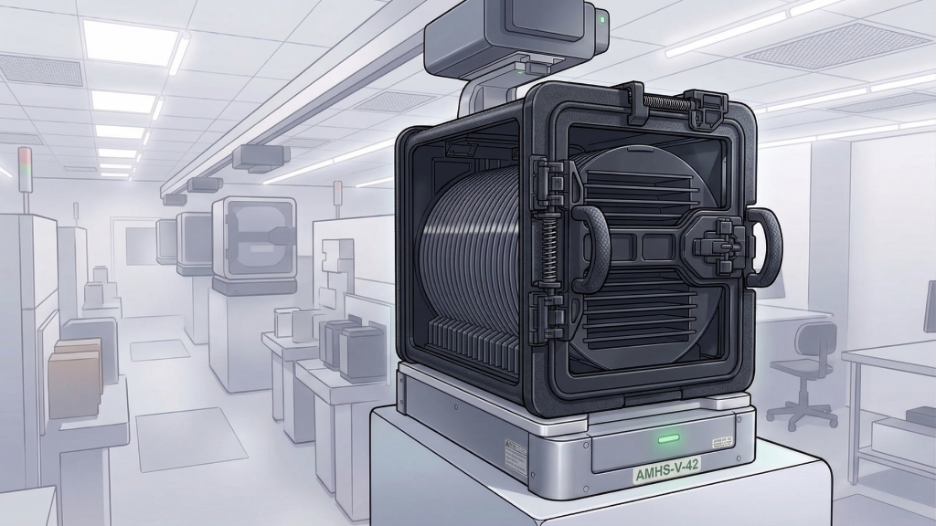
In advanced fabrication environments, wafers operate within a strictly hands-free ecosystem, transitioning between processes via overhead hoist transfers (OHT) and robotic end-effectors. A single, fully loaded FOUP represents millions of dollars in mission-critical silicon value.
-
The Financial Stakes:
A dimensional drift of a mere 0.5 mm can compromise the critical interface between robotic effectors and the pod. Such misalignments extend beyond individual unit failures; they trigger catastrophic "line-stop" events, where operational downtime can incur losses exceeding thousands of dollars per minute. -
The Material Challenge:
Processing specialized polymers like Polycarbonate (PC) or PEEK—often compounded with Carbon Nanotubes (CNT) for ESD performance—demands precise control over elevated processing temperatures. These materials typically require melt temperatures of 280°C–300°C and mold temperatures of 100°C–120°C to achieve proper flow and consolidation, placing exceptionally high demands on process control. Our 3000-ton systems are engineered to navigate this “thermal tightrope”—meticulously balancing rapid quenching with minimal residual stress to preclude long-term warpage.
Technical Challenges in High-Precision FOUP Injection Molding
Producing FOUP components involves several complex engineering challenges.
-
Warpage and Residual Internal Stress
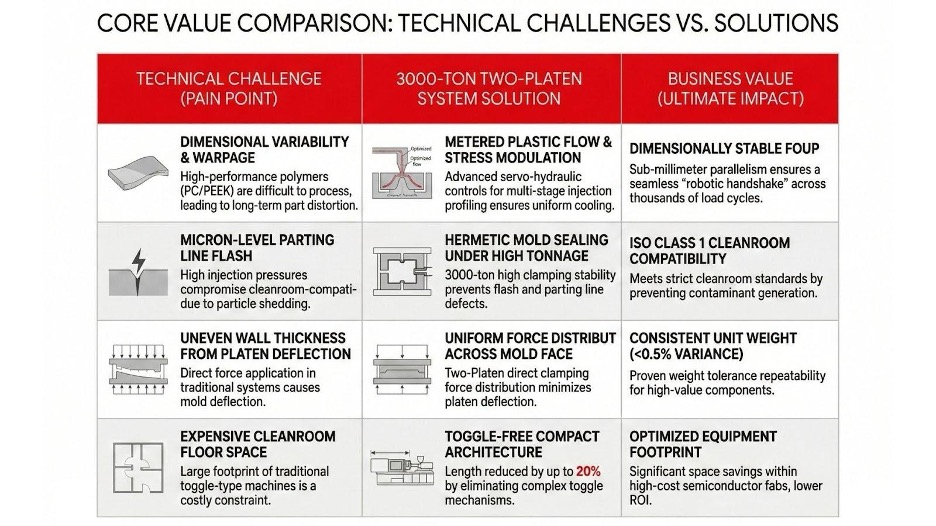
Processing high-performance polymers such as Polycarbonate (PC) and PEEK—often compounded with Carbon Nanotubes (CNT)—requires melt temperatures of 280°C–300°C and mold temperatures of 100°C–120°C, combined with low-speed, high-pressure molding to ensure proper fill and consolidation. Excessive injection speed causes an instantaneous spike in melt temperature, inducing material degradation and amplifying non-uniform cooling across the part—the primary driver of residual stress buildup, which ultimately manifests as warpage or dimensional drift. Given the substantial scale and geometric complexity of FOUP architectures, precise thermal management, optimized cooling circuit design, and a high-rigidity clamping mechanism are all essential to maintaining dimensional integrity throughout the molding cycle.
-
Robotic Interface and AMHS Compatibility
Modern fabs operate via fully autonomous logistics, where robotic end-effectors and AGVs manage all transport. Even micro-deviations in FOUP dimensions can compromise gripper alignment, triggering cascading system errors or costly operational paralysis. In this context, precision is not just a metric—it is a prerequisite for fab-wide continuity.
-
Surface Integrity and Contamination Mitigation
FOUPs require pristine surface finishes to shield wafers from sub-micron contaminants. Manufacturing anomalies—such as parting-line flash or micro-particle shedding—undermine sealing performance and breach cleanroom protocols. To mitigate these risks, 3000-ton two-platen injection molding systems have emerged as the premier industry solution. These high-tonnage platforms provide the requisite clamping stability and platen parallelism to produce large-format carriers with uncompromising precision.
Read More: Injection Molding Machine Troubleshooting: Common Issues and Solutions
Read More: Types of Injection Molding Machine : Choose Hydraulic, Electric or Hybrid Wisely
Why 3000-Ton Two-Platen Injection Molding Machines Are Essential for FOUP Production
Fabricating a Front Opening Unified Pod (FOUP) poses a sophisticated engineering paradox: it necessitates massive clamping forces to secure large-scale molds, while simultaneously demanding surgical precision to mitigate microscopic material stress. The 3000-ton two-platen system stands as the definitive solution to this duality, underpinned by three critical technical pillars:
-
Exceptional Clamping Stability and Flash Prevention
FOUP components are large-surface-area structural parts. During the low-speed, high-pressure injection of engineering plastics like Polycarbonate (PC), the internal cavity pressure is immense.
-
The 3000-Ton Advantage:
This high tonnage ensures the mold remains hermetically sealed against peak injection pressures. -
Technical Impact:
By maintaining a rigid seal, the machine eliminates "flash" (excess material leakage) and prevents parting line defects, ensuring the FOUP meets the strict airtightness standards required for ISO Class 1 cleanroom compatibility.
Read More: How to calculate the required clamping tonnage for your application
-
-
Micron-Level Platen Rigidity and Deflection Control
Standard machines often suffer from "platen wrap" or deflection when dealing with high-tonnage requirements, which leads to uneven wall thickness in the molded carrier.
-
Two-Platen Architecture:
Unlike traditional toggle systems, the two-platen injection molding machine applies clamping force directly and evenly across the mold face. -
Technical Impact:
This uniform force distribution minimizes mold deflection, ensuring that the 300 mm wafer slots inside the FOUP are aligned with sub-millimeter parallelism. This is essential for the seamless "robotic handshake" required by Automated Material Handling Systems (AMHS).
-
-
Optimized Thermal and Stress Management
High-performance polymers (PC/PEEK) require high melt temperatures. If the machine’s injection unit, holding pressure control, and cooling balance time are not precisely managed, the part will develop internal residual stress, leading to long-term warpage.
-
Precision Injection Control:
Modern 3000-ton systems feature advanced servo-hydraulic controls that allow for multi-stage injection profiling. Learn more about how machine drive types affect process precision. -
Technical Impact:
By precisely modulating the flow front and holding pressure, the machine ensures the FOUP cools uniformly. This results in a dimensionally stable product that will not warp over thousands of load cycles in a high-speed semiconductor fab.
Read more: How to Calculate Injection Molding Tonnage: A Step-by-Step Guide
-
Advantages of Two-Platen Injection Molding Machines for Cleanroom Fabrication
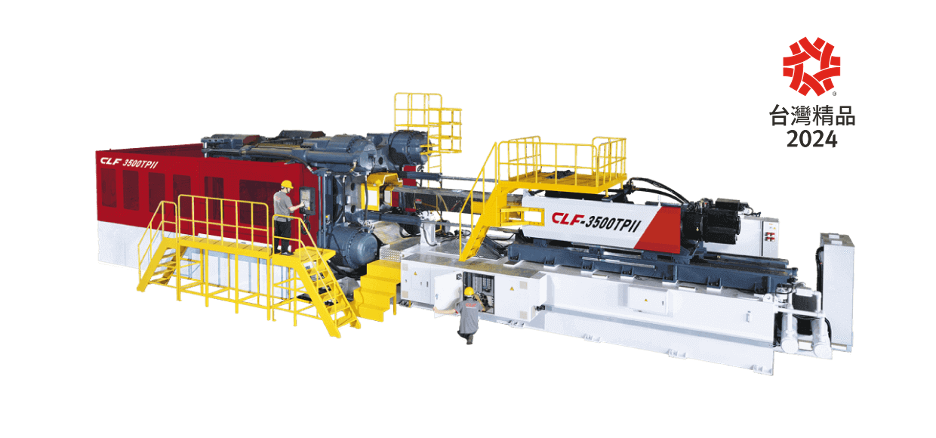
Two-platen injection molding platforms, exemplified by the CLF TPII series, are increasingly leveraged for the production of high-precision components like FOUP containers.
Optimized Equipment Footprint
- Traditional toggle-type machines require long mechanical structures due to their linkage systems.
- Two-platen machines eliminate complex toggle mechanisms, allowing the machine length to be reduced by up to 20%.
- This design provides significant space savings inside expensive semiconductor cleanroom facilities.
Uniform Clamping Force Distribution
- Two Platen Plastic Molding Machines apply clamping force through direct hydraulic systems.
- This allows pressure to be distributed evenly across large molds, preventing mold deflection and ensuring stable cavity geometry.
Improved Dimensional Stability
- Stable clamping pressure helps prevent molding defects such as flash, internal stress, and warpage.
- This ensures that FOUP components meet the strict dimensional requirements required for semiconductor automation systems.
For a detailed comparison, see our guide: Two-Platen vs. Three-Platen Injection Molding Machines: Which One is Right for You?
The Integrated 5-Stage FOUP Fabrication and Quality Assurance Framework
The production of FOUP components involves several controlled manufacturing stages:
-
Advanced Material Desiccation
High-performance polymers such as PC and PEEK must undergo thorough dehumidification drying—typically 3–5 hours at the recommended temperature—prior to processing to eliminate absorbed moisture. Inadequate drying leads to severe molding defects, commonly manifesting as silver streaks, bubbles, whitening, voids, or jetting marks on the finished surface. In severe cases, hydrolytic degradation reduces mechanical strength, causes embrittlement, destabilizes melt flow, and can result in short shots (incomplete fill).
-
High-Tonnage Precision Molding
Leveraging 2000–3000 ton injection molding systems, this stage ensures absolute structural rigidity and mold closure during high-pressure injection, precluding the formation of micro-flashing.
-
Calibrated Thermal Management
Advanced cooling protocols are meticulously synchronized to optimize cycle times while mitigating internal residual stress, effectively neutralizing the risk of post-molding warpage.
-
Automated Metrological Verification
Critical dimensions are subjected to rigorous metrological inspection to ensure micron-level compatibility with the industry’s sophisticated robotic wafer-handling interfaces.
-
Digital Ecosystem Integration
Through the deployment of IoT sensors and Digital Twin modeling, the production line operates within a predictive environment, facilitating 100% quality assurance and real-time process optimization.
Proven Performance: Trusted by Global Industry Leaders
With a heritage spanning sixty years of engineering mastery, Chuan Lih Fa (CLF) has established itself as the definitive partner for the high-precision semiconductor supply chain. Our reputation is built on a foundation of reliability, innovation, and measurable results.
-
Global Footprint & On-Site Expertise
CLF serves a sophisticated clientele across more than 80 countries. We provide specialized on-site consulting and proactive technical stewardship to ensure uninterrupted production stability for every partner.
-
A Record of Precision for Tier-1 Manufacturers
Our customized systems have consistently met the rigorous standards of Tier-1 suppliers, achieving an impressive weight variance of less than 0.5%—a testament to our machine's repeatable accuracy.
-
Unmatched Client Loyalty
Driven by the superior stability and spatial efficiency of our TPII series, over 80% of our first-time large-tonnage machine purchasers choose CLF for their subsequent capital reinvestments.
-
Strategic Ecosystem Integration
Through synergistic collaborations with global industry leaders and academic research institutions, we continue to spearhead advancements in Industry 4.0, smart manufacturing, and autonomous process optimization.
Trust the Numbers: 60 Years of Engineering Authority
At Chuan Lih Fa (CLF), we understand that investment in a 3000-ton system is a 10-year strategic move. Our data speaks for itself:
-
Tier-1 Reliability:
We consistently achieve weight tolerances within 0.5% for high-value components. -
The "Partner" Metric:
Over 80% of our large-machine clients return for repeat investments. Why? Because we provide more than hardware; we provide the production stability that keeps their contracts secure.
Future-Proofing Your Semiconductor Supply Chain
The semiconductor era demands infrastructure that matches its ambition. As AI and advanced electronics scale, the demand for high-integrity FOUPs will only accelerate. Investing in a 3000-ton two-platen system is your commitment to precision, efficiency, and long-term competitiveness.
Looking for a FOUP Injection Molding Solution?
At Chuan Lih Fa (CLF), we specialize in large-tonnage two-platen injection molding machines designed for high-precision semiconductor applications. With nearly 60 years of engineering expertise and installations in more than 80 countries, CLF helps manufacturers achieve stable and efficient FOUP production.
Contact our team to learn more about customized injection molding solutions for semiconductor manufacturing.