
German, Japanese, or Asian?Three Engineering Philosophies Behind the Injection Molding Machine You're About to Buy
German, Japanese, and Taiwanese injection molding machines are built around three different engineering priorities — process control, long-term uptime, and adaptability — and the right choice depends on your tolerance requirements, not your budget alone.
Three Quotes. Same Tonnage. Very Different Machines
You've got three quotes on your desk — one German, one Japanese, one Taiwanese. The tonnage is identical. The price gap is three-to-one. Every sales rep tells you theirs is the right call, and none of them are lying, exactly. They're just answering a different question than the one you're actually trying to solve.
This article won't tell you which brand to buy. What it will do is lay out the engineering logic behind each regional approach — what each school of thought was built to solve, where it genuinely outperforms the others, and where the premium stops being worth it. By the end, you'll have a clearer frame for matching machine philosophy to production reality, not just spec sheet to spec sheet.
The Real Reason Two Machines with Identical Specs Feel Nothing Alike
Brand-to-brand comparison is how most procurement conversations start — and where most of them stall. Two machines from different brands in the same region will typically feel more alike in operation than two machines from different regions running the same tonnage class. The reason isn't marketing. The engineers who built them trained in the same quality culture, cut their teeth on the same customer demands, and inherited the same set of assumptions about what a well-built press should do.
The German School — Built Around Process Control
German injection molding machines are engineered around one question: how do we eliminate process variation?
That discipline traces back decades to the demands of Germany's automotive supply chain. Tier 1 suppliers operating within the VDA (Verband der Automobilindustrie) quality framework required shot-by-shot process data long before it became standard practice elsewhere. German equipment makers responded by designing control into the machine at every level — closed-loop systems throughout, in-mold cavity pressure sensors as standard equipment rather than an add-on, and factory acceptance tests (FATs) that take considerably longer to complete than those for Asian-built equipment.
The trade-off is straightforward. German equipment commands the highest sticker price on the market and the longest lead times — typically 20 weeks or more. That's not always the right call. But for applications where tolerances tighter than ±0.02 mm are non-negotiable and a single out-of-spec part can void a month's shipment — medical-grade components, precision optical elements, high-end automotive connectors — the investment calculus is clear.
The Japanese School — Built for the Long Run
Japanese injection molding machines are engineered around a different question: how do we keep this machine running flawlessly a decade from now?
The philosophy is rooted in Toyota Production System (TPS) thinking, rigorous supplier discipline, and all-electric drive technology that Japan commercialized in the 1980s — well ahead of the rest of the industry. The result is machines that prioritize long-term repeatability and uptime over raw configurability.
The trade-off: pricing that sits close to European levels, and a product lineup that can feel feature-conservative by comparison. Where that premium earns its keep is in operations that cannot afford unplanned stops — 24/7 lights-out production, ISO cleanroom medical molding, precision optical components, and high-volume electronic connector runs.
The Asian School — Built to Adapt
The Asian school was forged in the dense mold-making and contract-molding ecosystems of Taiwan and mainland China. Machines built here had to process virtually any resin, ship within weeks, and turn a margin on competitive pricing — and that pressure produced a fundamentally different design language from either the German or Japanese approach.
That design language shows up as: close customer proximity, highly modular machine configurations, faster ex-works lead times, and regional spare-parts distribution that keeps downtime manageable when something does go wrong.
The honest trade-off: significant brand fragmentation. Build quality and after-sales depth vary far more sharply across Asian makers than across the German or Japanese tiers. Treat 'Asian school' as a starting category, not a buying decision — individual manufacturer evaluation is essential.
Where the value proposition holds: high-mix custom contract molding, packaging, consumer goods, and large-tonnage two-platen applications where the European premium does not translate into a meaningfully better part or a defensible price increase to your own customer.
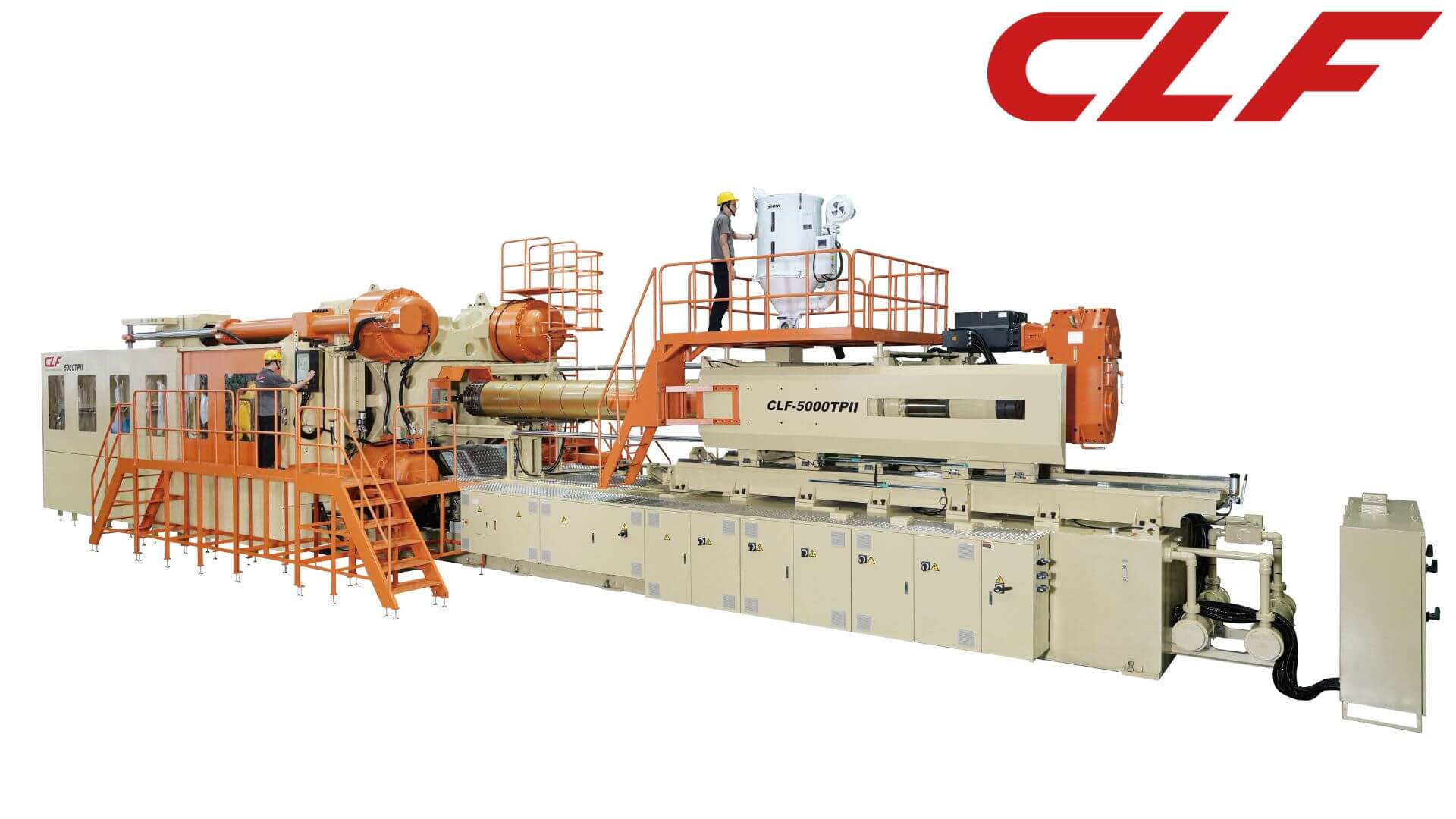
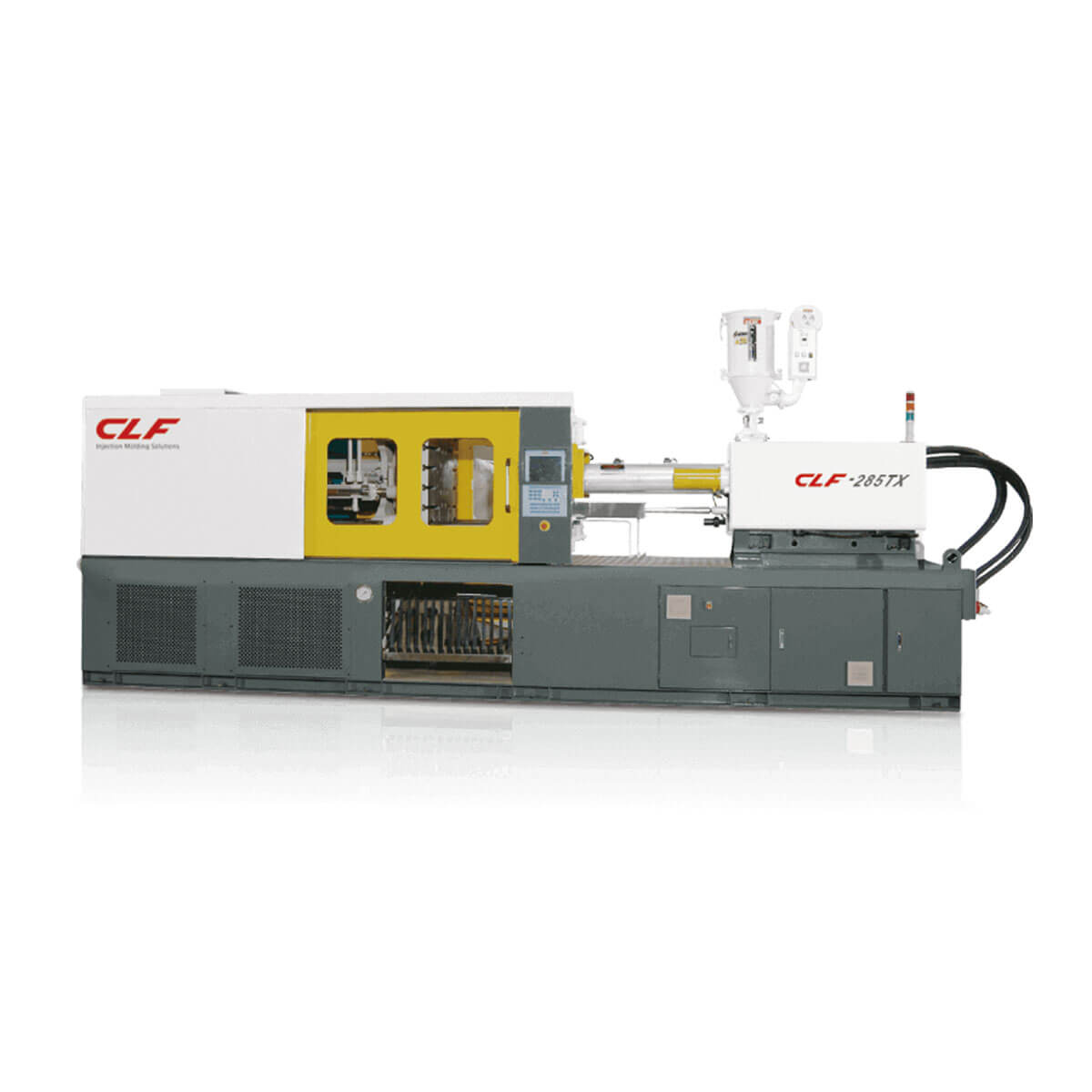
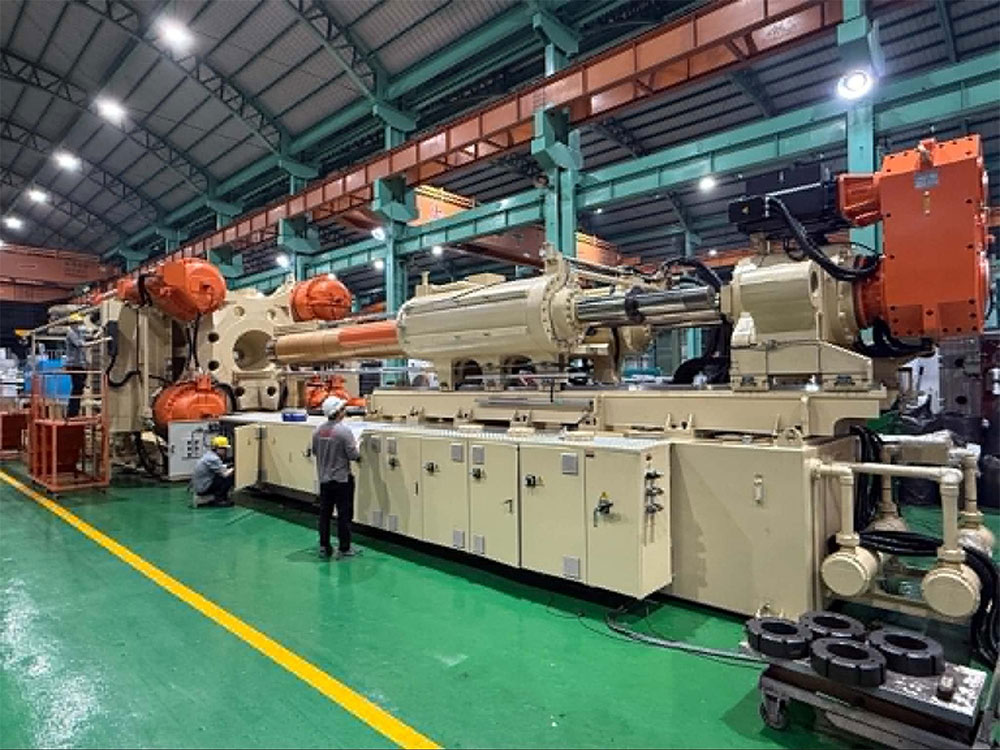
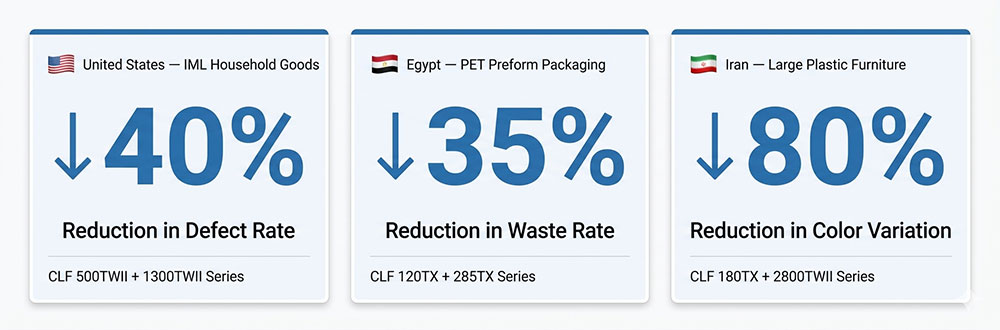
CLF occupies the higher end of the Asian tier. Our machines run in active production across more than 50 countries — from IML household goods lines and 100% recycled-resin pallet production in North America, to PET preform packaging in Egypt, large-furniture molding in Iran, and PVC fitting production in Saudi Arabia. What distinguishes CLF within the Asian school is not a single headline specification. It's the combination of deep application-specific customization — for example, achieving part weight variance within ±0.5% on automotive bumper tooling — modular machine configurations that cover everything from standard servo-hydraulic presses to multi-color platforms and two-platen machines up to 5,000 tons, and a global distribution network that provides both direct and indirect after-sales support across the Americas, the Middle East, Africa, and Southeast Asia.
The Three Schools at a Glance
The table below is a starting frame, not a verdict. Every machine purchase ultimately comes down to the application, the end customer's requirements, and the people who will run the line day to day.
| German School | Japanese School | Asian School | |
|---|---|---|---|
| Engineers optimize for... | Process precision & repeatability | Long-term uptime & reliability | Adaptability, lead time & TCO |
| Typical strength | Tightest process tolerances | Highest long-term reliability | Fastest delivery, best total cost of ownership |
| Typical trade-off | Highest capital cost, longest lead time | Premium pricing, feature-conservative | Support quality varies significantly by maker |
Which School Fits Your Plant?
A rough decision guide — not a prescription. These three scenarios account for the majority of what we see in the field:
- If your spec sheet carries tolerances tighter than ±0.02 mm and your customer conducts process audits, the German school is your starting point.
- If your plant runs 24/7 and a single hour of unplanned downtime costs more than the price premium between a Japanese press and an Asian alternative, the Japanese school is where the math points.
- If your production mix covers packaging, consumer goods, or a diversified job shop portfolio — particularly if you're buying above 600 tons — the Asian school is typically where the investment returns are strongest.
Most plants we've worked with end up running a mixed fleet. The best procurement teams aren't loyal to a region — they're loyal to the part.
Read more: Two-Platen vs. Three-Platen Injection Molding Machines: Which One Is Right for You?
What Separates CLF from the Rest of the Asian Tier
When customers choose CLF, the decision usually comes down to three things:
-
Application-specific results.
On automotive bumper production, for example, our machines have held part weight variance within ±0.5% — a benchmark that directly determines whether a bumper ships or scraps. Across other markets, we've helped customers cut reject rates by 35–45% and reduce cycle times by 20–30%, depending on the application and resin. -
Machine range that covers the full tonnage spectrum.
From standard servo-hydraulic presses for packaging and consumer goods through to multi-color platforms and two-platen machines up to 5,000 tons for large-format structural parts — without switching supplier mid-fleet. -
Global distribution with local reach.
CLF's worldwide distributor network delivers both direct and indirect after-sales coverage across the Americas, the Middle East, Africa, and Southeast Asia. If you're evaluating us for a specific geography, ask us for the service coverage map — we'd rather show you the gaps honestly than oversell the network.
Read more: Customized Plastic Injection Machine — 3 Advantages & Case Studies
CLF machines run in active production across more than 50 countries. If you're evaluating equipment for packaging, large-tonnage, or high-mix production, we're worth a direct conversation.
Common Questions from Buyers Evaluating Across Regions
Q1: Are Taiwan-built injection molding machines comparable in quality to Japanese ones?
Yes — for a broad range of applications. Taiwanese manufacturers have closed the performance gap substantially over the past two decades, particularly in servo-hydraulic and hybrid drive systems. For packaging, consumer goods, and mid-precision industrial parts, the quality difference is negligible in day-to-day production. The honest caveat: for applications where long-term dimensional stability under continuous high-load cycling is the primary design constraint — certain precision electronic connectors, tight-tolerance medical components — Japanese machines retain a measurable edge. Outside that narrow band, the specification overlap is significant.
Q2: Why are European machines so much more expensive than Asian ones?
The gap reflects a combination of higher manufacturing labor costs, more rigorous build standards, deeper pre-delivery validation cycles, and a more expensive European-sourced supply chain — not brand premium alone. That said, the premium is only justified when your application genuinely demands the specification it delivers. Paying for German-school validation depth on a consumer goods line is money that doesn't come back.
Q3: Can I run machines from different regions in the same plant?
Yes, and most well-managed plants do exactly that. The right basis for that decision is the part — its tolerance requirements, cycle time targets, and qualification needs — not regional brand loyalty. Mixed fleets are standard practice; the goal is matching the right machine to the right application, not standardizing on a flag. If you're evaluating specific machine types, our guides on toggle vs. two-platen systems and hydraulic, electric, and hybrid drives are a useful starting point.
Q4: If I buy a CLF machine, what does after-sales support look like outside Taiwan?
This is the right question to put to any Asian-school maker — and the answer matters more than the machine spec in many markets. CLF operates a worldwide distributor network that provides both direct and indirect service coverage across the Americas, the Middle East, Africa, and Southeast Asia — regions where we have machines in active daily production. Response capability varies by geography; we'd encourage you to ask us specifically about your market rather than accept a blanket answer. What we can commit to: transparent coverage maps, regional spare-parts availability, and on-site commissioning and operator training at the point of installation.
Read more: CLF's Support for Injection Molding Solutions in ASEAN / Southeast Asia
Not Sure Which Direction Fits Your Application?
At this stage of the evaluation, most procurement decisions turn on three inputs: part geometry and tolerance requirements, annual production volume, and plant location. If you'd like CLF to run a no-commitment application assessment — tell us those three things and we'll give you a straight answer on whether we're the right fit, and if not, why not.